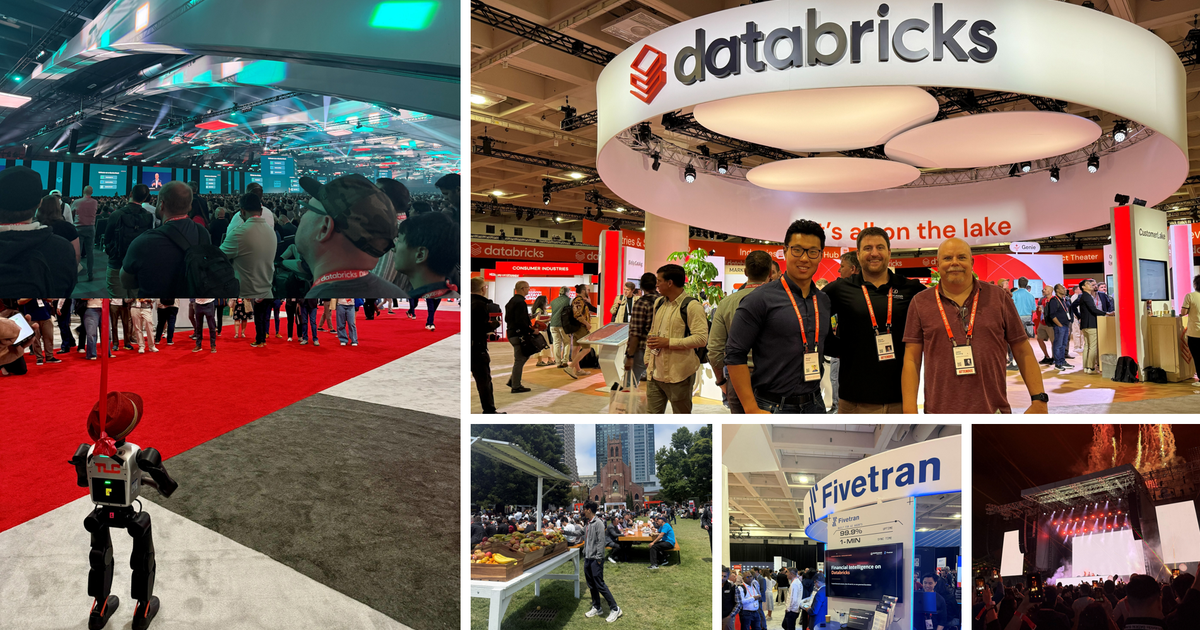
Scenes from the Databricks Data + AI Summit 2026 in San Francisco, including time at the Fivetran booth and the QuickLaunch team on the show floor.
AI doesn’t have an intelligence problem. It has a context problem. That was the line CEO Ali Ghodsi opened the Databricks Data + AI Summit with last week. The summit ran four days and more than 800 sessions in San Francisco, and the idea surfaced in nearly every room I sat in. The models are good enough. What holds enterprise AI back is whether the AI can reach governed, well-defined business context, and that context comes from two things most companies are still building: a trustworthy data foundation and an enterprise-grade semantic layer on top of it.
I lead marketing at QuickLaunch Analytics now, but I came up building enterprise data models in Power BI for our customers, so that’s the lens applied here: what these announcements mean if you’re a mid-market or enterprise data leader deciding where to invest this year.
The bottleneck is context, not the AI models
The agentic story dominated the agenda. Of the 800-plus breakout sessions, the AI and Agents track alone was nearly a third of the catalog, more than double the next largest track. And “Context engineering” had a track of its own.
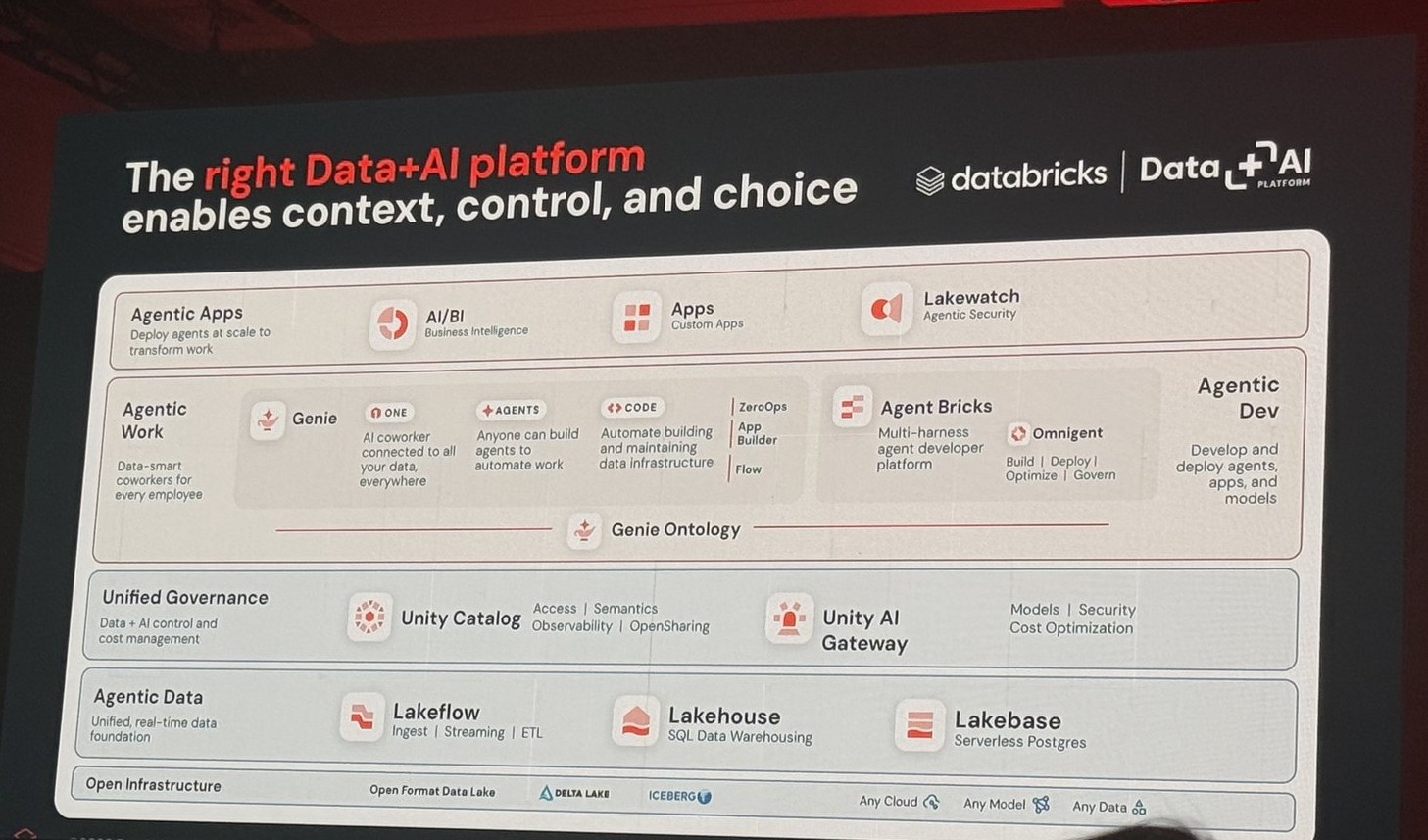
Databricks framed its platform around context, control, and choice, reaching from the data foundation up through semantics, BI, and agents.
What stood out more than the volume of sessions was who was on stage. These weren’t vendor demos on sample data. They were operating companies walking through production systems: Circle K on customer data and loyalty, HP on its go-to-market data foundation, Ensemble Health Partners running an 800-terabyte revenue-cycle workload, Mercedes-Benz Korea on letting business users talk to their data. Enterprises in manufacturing, healthcare, financial services, and retail were past the demo stage and into the part where the data has to hold up under real use.
The clearest evidence came from a session on building quality Genie agents (Genie is Databricks’ natural-language analytics agent). Genie lets people query Databricks data in plain language, and one of the summit’s bigger moves was turning what used to be called Genie Spaces into full Genie Agents, able to work with files, connect to other tools via MCP, and take actions, not only answer questions. The number that stuck with me was about accuracy. A Genie agent grounded in governed, modeled data answered real business questions at 73.8 percent accuracy, against 32.1 percent for a general-purpose code agent on the same data, and at roughly a quarter of the cost (Databricks, Data + AI Summit 2026). Same questions, same database. One had a semantic layer to stand on. The other was guessing at raw tables.
That gap is at the heart of the enterprise AI problem, and it isn’t a model-quality issue. It’s a data-readiness issue, and the research agrees. Fivetran and Redpoint found that 42 percent of enterprises say more than half of their AI projects have failed on data readiness (Fivetran/Redpoint, 2025). The Modern Data Company found that 80 percent of practitioners rank a governed semantic layer as the most important enabler of AI value (The Modern Data Company, 2026).
Databricks is building up the stack, not just out
The semantic layer was never a nice-to-have. You can’t build a trustworthy dashboard or report without one, which is why companies have modeled enterprise semantics in Power BI and similar tools for years. What changed at the summit isn’t that semantics suddenly matter. It’s that Databricks, which built its reputation on the data-engineering and lakehouse layers, is now investing hard in the semantic and presentation layers it long treated as secondary.
The foundation was already in place before the summit. Databricks made Unity Catalog Business Semantics, including Metric Views, generally available in April 2026, with materialization for performance and a point-and-click authoring UI. What the summit added sits on top of that foundation. The Genie Ontology, a permissions-aware layer that learns from your modeled semantics and connected systems to ground answers in verified, ranked Snippets. A Business Glossary (preview coming soon) that pins down what terms like “active customer” or “net revenue” mean. And Domains, which scope an agent to a business area like Finance instead of the whole catalog. The message was that Databricks intends to own the full stack, from data foundation up through semantics, BI, and agents.
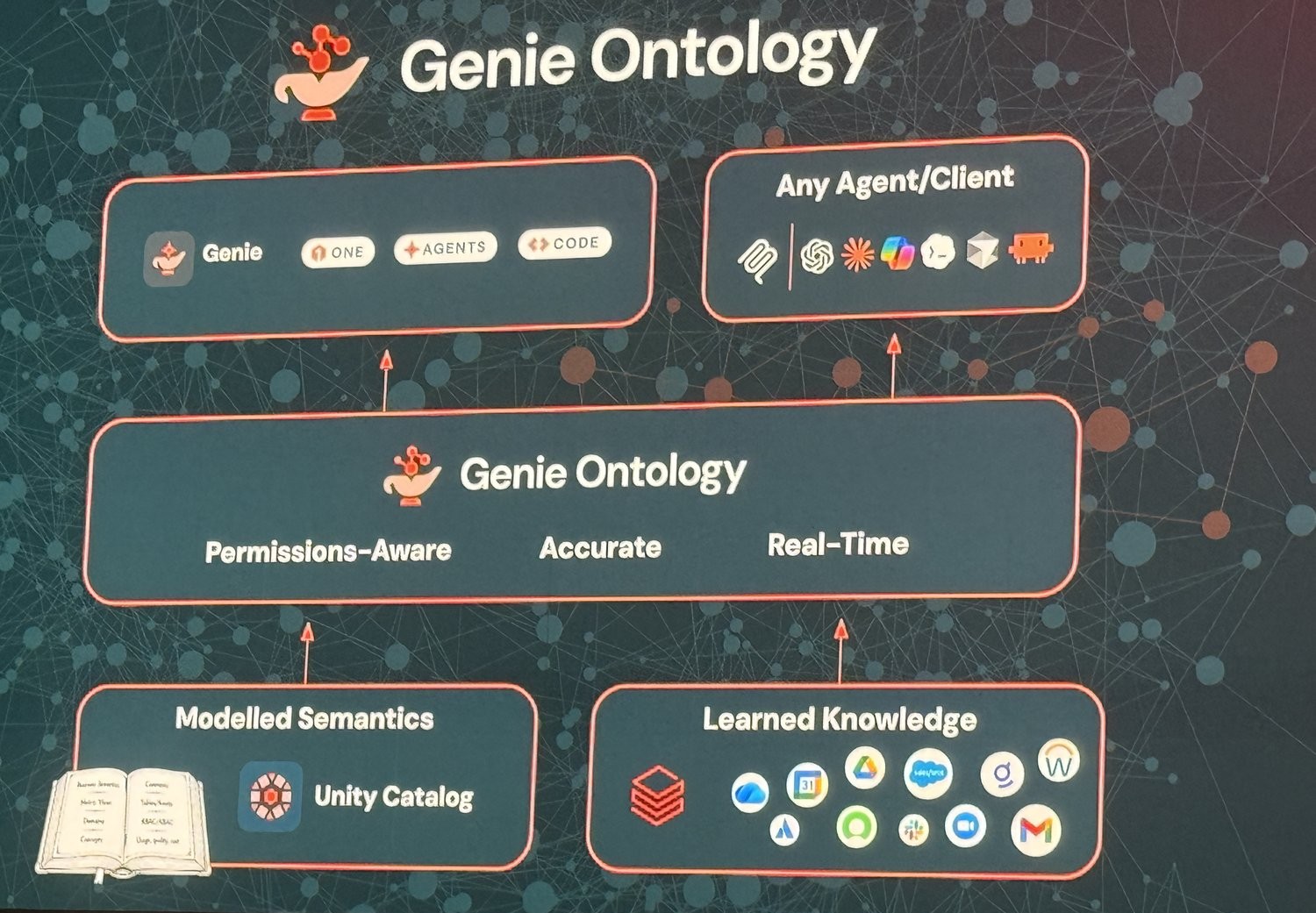
The Genie Ontology combines your modeled Unity Catalog semantics with automatically learned knowledge to ground answers, permissions-aware and in real time. The better the model underneath, the better the answer.
For a data leader, the takeaway is that the semantic layer is becoming first-class inside the platform many of you are standardizing on. The modeling itself, your metrics, your glossary, your domains, is still yours to do. Context isn’t a capability you switch on. It’s a layer you build and govern.
Don’t underestimate the semantic-layer migration
If your semantic models live in Power BI or Tableau, the question is how you move them into Unity Catalog to leverage AI/BI, Genie, and AgentBricks. Databricks’ answer is Genie Code: point it at a Power BI report (or a Tableau workbook) and it generates a Databricks AI/BI dashboard wired to Unity Catalog Metric Views. Stated precisely, it’s in beta, one report at a time, and migrating all your reports at once is still on the roadmap.
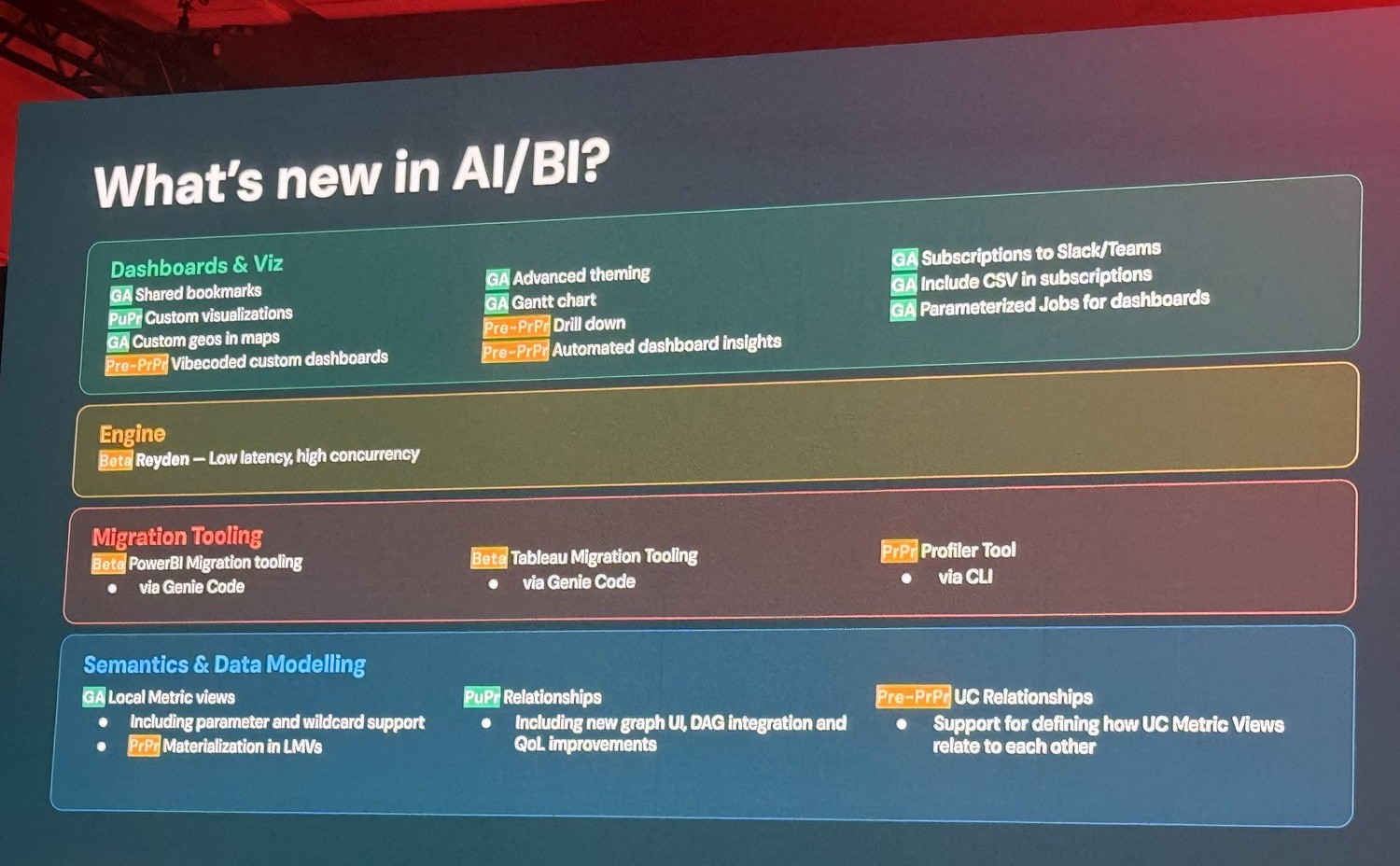
The AI/BI roadmap, including the beta Power BI and Tableau migration tooling that runs through Genie Code.
The most useful look at the real difficulty came from the customers presenting their own migrations. Mercedes-Benz Korea walked through the AI-assisted process they built to translate Power BI DAX measures into Metric Views, across more than 600 KPIs. Their numbers are the honest version: roughly 40 percent of the measures converted cleanly, the rest needed manual work, and the automated run flagged 187 missing join conditions out of 684 measures. HP presented a comparable effort moving its ThoughtSpot semantic layer onto Databricks.
That difficulty isn’t a knock on the tooling. It’s the nature of moving a semantic layer between two engines. DAX gets its power from evaluation context, the way CALCULATE rewrites filters at query time, and a declarative Metric View has no clean equivalent. Time-intelligence has to be re-authored, and the relationships a Power BI model resolves for you have to be made explicit, which is why so many measures came back flagged for missing joins. Row-level security and complex measures rarely auto-translate.
So the honest read is that migrating a semantic layer is its own project, not a one-click conversion: automation handles the simple measures, but the complex ones, the joins, and the security rules need expert judgment. If you’re moving to the lakehouse, treat the semantic layer as its own workstream.
The lakehouse is the new warehouse
The other thing worth watching is the foundation itself, where your data warehouse lives. A big share of the keynote argued that the best data warehouse is now a lakehouse, and the product news backed it: the lakehouse has closed most of the gap on SQL feature parity and on performance. Databricks says more than 60 percent of the Fortune 500 already use it for warehousing (Databricks, Data + AI Summit 2026). The pitch to anyone still running a separate warehouse next to a lakehouse is consolidation: one governed copy of the data for BI, ETL, and AI, instead of a warehouse for reports and a lakehouse for everything else.
For teams moving off Teradata, Netezza, Synapse, or a legacy Redshift, Databricks’ Lakebridge tool handles the mechanics: it scans the source, converts the code, moves the data, and reconciles the result. For a lot of enterprises, that consolidation is the right call, and the tooling to do it has matured. Landing your warehouse on the lakehouse gives the data one governed home to build on.
Cost moved to the front of the conversation
The other theme running through the week was money, and Databricks didn’t hide from it. Ghodsi was candid that running AI at scale gets expensive. Agents are token-hungry, and pointing a general-purpose agent at raw data is both less accurate and more expensive. The benchmark from earlier makes the point: the grounded Genie agent didn’t only answer more accurately, it ran at roughly a quarter of the cost. A modeled semantic layer is one of the cheaper ways to control AI spend, because the agent does less work to reach the right answer.
Databricks paired that with governance built for cost. The Unity AI Gateway sits alongside your data and controls which models and agents can run, with spend caps and routing so a runaway agent can’t quietly burn the budget. Collapsing redundant tiers, like running BI and AI on one governed copy of the data instead of a separate warehouse, takes cost down from the other side.
For a data leader, AI spend is now a line item to govern, not a surprise to absorb. The same modeling work that makes answers trustworthy is what keeps them affordable.
What it means heading into the rest of 2026
There’s a single thread under all of it. Genie Agents, AI/BI, the Ontology, the Unity Catalog semantic layer: every one of them pays off in proportion to how well your data is already governed and modeled, and every one widens the gap for the teams that haven’t done that work.
That groundwork is demanding, which is the point. Agreeing on what your metrics mean, modeling the relationships in your source systems, and governing the whole thing is the layer that decides whether the AI on top of it delivers. Ghodsi was right that the constraint is context. What’s worth sitting with is that no platform hands you that context. You build it and you own it for your own business.
If you’re trying to work out whether your data is ready for what’s coming, we teamed up with Fivetran on a playbook that walks through it: Building AI That Works: The AI Readiness Playbook. It’s a straight read on what AI needs from your data, and how to get there.
Is Your Data Ready for What’s Next?
We teamed up with Fivetran on Building AI That Works: The AI Readiness Playbook, a straight read on what AI needs from your data and a practical path to get there.