Picture this: It’s Monday morning, and you’re walking into a critical board meeting armed with what you believe are your company’s most important performance metrics. Five minutes into your presentation, your CFO interrupts with a completely different set of numbers for the same KPIs. Your VP of Sales chimes in with yet another figure. Suddenly, instead of discussing strategy, you’re debating which system has the “real” data.
This is the frustrating reality in most organizations. You’re not suffering from a lack of data; you’re suffering from a lack of enterprise BI integration.
When business intelligence systems and the data that feeds them operate in disconnected silos, they create confusion, erode trust, and prevent you from seeing the full picture of your business. This fragmentation isn’t just an inconvenience; it’s a significant drag on performance. Research from McKinsey Global Institute shows that knowledge workers spend nearly 20% of their work week, the equivalent of one full day, simply searching for and organizing the information they need to do their jobs effectively.
True enterprise intelligence isn’t about having more dashboards; it’s about having a single, unified view through effective business intelligence consolidation. Achieving this requires a deliberate enterprise BI integration strategy. This guide provides a proven, three-step framework to move from a state of BI chaos to one of cohesive, enterprise-wide clarity.
Why Enterprise BI Integration is Critical: The High Cost of BI Chaos
Before diving into the solution, it’s important to understand the tangible costs of inaction. Operating with disconnected BI systems imposes a hidden Data Silo Tax on your business that shows up in five key areas.
of the work week spent searching for and organizing information
McKinsey Global Institute
The Productivity Drain
Your skilled analysts and managers spend hours manually exporting data from multiple systems into spreadsheets, attempting to reconcile conflicting numbers, and piecing together reports. This low-value “data janitor” work is a direct drain on payroll and a primary cause of burnout for your best talent.
Strategic Decision Paralysis
Gartner estimates that poor data quality costs organizations an average of $12.9 million every year. When leaders are presented with conflicting reports from sales and finance, meetings devolve into debates about whose numbers are right rather than decisive strategic conversations. This lack of data confidence leads to hesitation, indecision, and a dangerous reliance on “gut feel.”
Eroded Trust
Inconsistent data creates a culture of mistrust. Business users learn to doubt the analytics provided by IT and revert to their own departmental “shadow IT” systems, usually spreadsheets, because they are the only numbers they feel they can control. This undermines the entire investment in a data-driven culture.
Technology Bloat
IT departments find themselves managing an expensive patchwork of overlapping BI tools, each with its own licensing costs, security requirements, and maintenance overhead. This tech debt grows exponentially, consuming budget that could be invested in higher-value work.
The Innovation Roadblock
Disconnected BI systems make advanced analytics initiatives nearly impossible. AI and machine learning projects require clean, connected, comprehensive data, something that’s virtually impossible to achieve in a fragmented environment without proper enterprise BI integration.
Enterprise BI Integration Framework: Connect, Centralize, Conquer
Escaping the high costs of BI chaos requires more than just new technology; it demands a new, strategic approach to BI system integration. A successful strategy must address three layers of the business: the foundational data pipelines that connect to your systems, the central platform where data is unified, and the business-facing analytics layer where insights are generated.
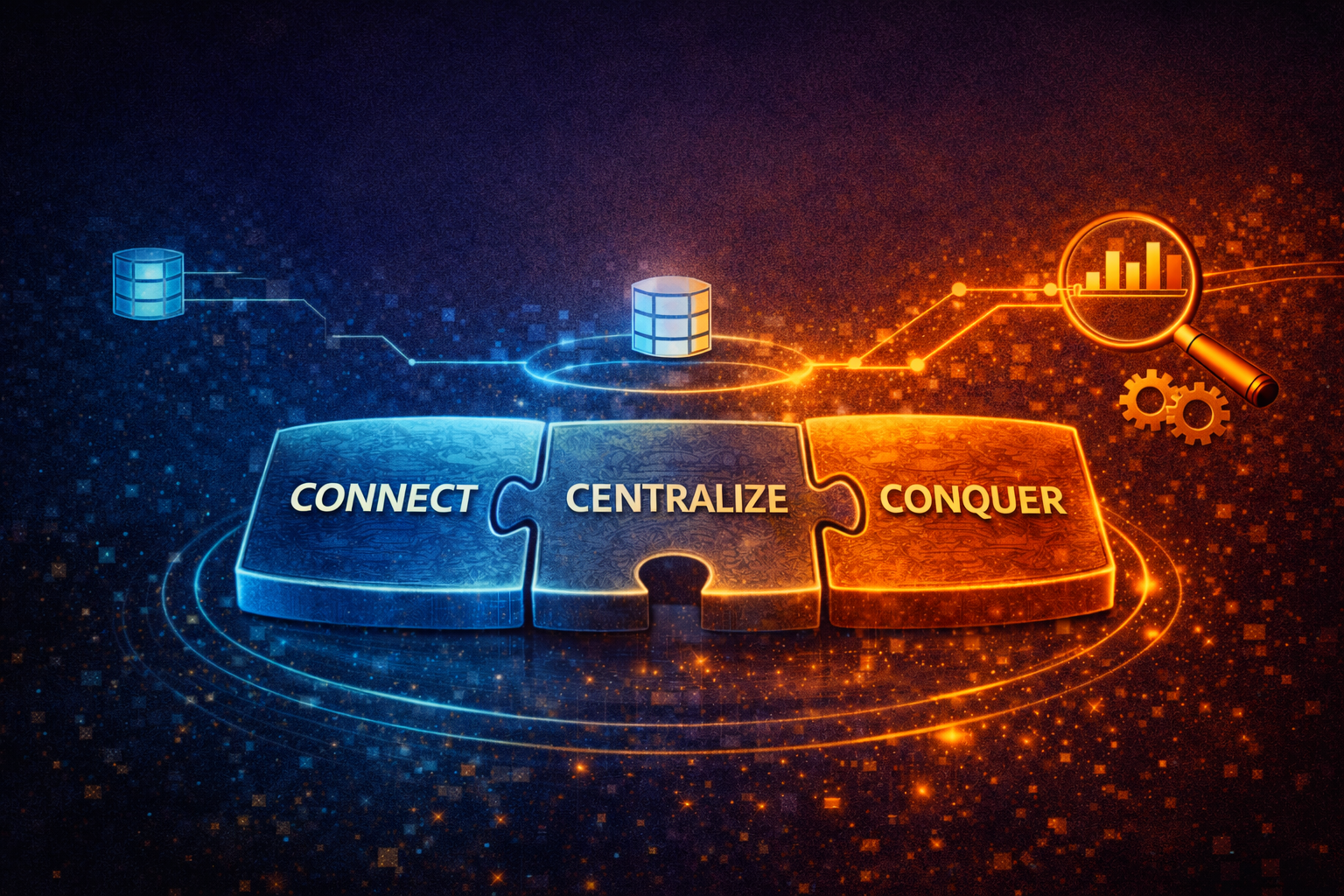
This proven enterprise BI integration methodology is called the Connect, Centralize, Conquer framework. It is a three-step blueprint designed to transform a fragmented data landscape into a cohesive engine for enterprise intelligence.
CONNECT: Create a Resilient Data Pipeline Layer
The foundation of any successful enterprise BI integration is the ability to reliably and efficiently connect to your various data sources. This means moving beyond the brittle, high-maintenance integration methods of the past.
The Limits of Traditional ETL
For years, the standard was custom-coded, point-to-point ETL (Extract, Transform, Load) processes. While functional for simpler environments, this approach fails in the modern enterprise. These custom connections are rigid; when a source system like your ERP is updated, the connection breaks, requiring costly IT intervention. This creates a constant cycle of maintenance and firefighting, and it simply cannot scale to accommodate the dozens or hundreds of systems in a typical organization.
The Modern Integration Layer
A modern enterprise BI integration strategy focuses on building an automated and resilient data pipeline layer:
Prioritize Automation Over Manual Extraction: Your first goal should be to eliminate manual data workflows. Instead of analysts exporting spreadsheets, your pipelines should automatically extract data from your core systems on a reliable schedule.
Use the Right Tool for the Source: A modern business intelligence consolidation strategy uses a combination of specialized tools. For SQL databases, use a direct replication tool optimized for high-performance data synchronization. For cloud applications, use an ELT service with pre-built API connectors for your SaaS platforms (such as Salesforce and NetSuite), ensuring connectivity is maintained even when those applications are updated.
Implement Change Data Capture (CDC): To maximize efficiency and minimize the load on your operational systems, your pipelines should use CDC. This technology intelligently identifies and processes only the data that has changed since the last update, enabling near-real-time synchronization without having to copy entire databases.
CENTRALIZE: Build a Unified Data Integration Platform
Once your data is flowing reliably through your enterprise BI integration pipelines, it needs a single, central home. Attempting to connect BI tools directly to a multitude of operational systems is a recipe for disaster. The modern, strategic approach is to centralize your data in a data lakehouse.
This architecture combines the flexibility of a data lake with the governance and performance of a traditional data warehouse, creating the ideal foundation for all enterprise analytics integration. Within the lakehouse, a medallion architecture is used to progressively refine the data:
- Bronze Zone: Raw, untouched data is ingested from the source systems, creating a complete historical archive for auditing and reprocessing.
- Silver Zone: The data is cleaned, standardized, and conformed. This is where data from different systems is reconciled to create a consistent and reliable source of truth.
- Gold Zone: Business-ready, aggregated datasets are created, optimized for high-performance analytics and reporting.
By centralizing your data before the analysis stage, you ensure that every BI tool and every user across the organization is working from the exact same governed, high-quality information.
CONQUER: Unify with Enterprise Semantic Models
The final and most critical step is to conquer the analysis gap. Even with clean, centralized data, you need a way to make it accessible and understandable to the business. This is the role of the enterprise semantic model in your enterprise BI integration strategy.
Think of the semantic model as a universal translator, a “business map” of your data. It is a logical layer that sits on top of your data lakehouse and serves all your BI tools.
It Standardizes Business Logic: Calculations for “Gross Profit” or “Customer Lifetime Value” are embedded in the model once, ensuring every report and every dashboard across the entire organization uses the exact same logic.
It Organizes Data into Logical Business Views: The semantic model takes the hundreds of clean tables available in the data foundation and organizes them into intuitive, subject-specific views called Perspectives. All data related to Accounts Payable, for example (vendors, invoices, payments), is presented together in a clean, curated environment.
It Enables True Self-Service: By providing an intuitive and governed view of the data, the semantic model empowers business users to answer their own questions and create their own insights in their BI tool of choice, freeing up your data team for more strategic work.
It Enables True Cross-Functional Analysis: The semantic model can unify data from traditionally separate business functions. For example, it can blend data from sales, inventory, procurement, and manufacturing into a single “Supply and Demand” perspective, allowing leaders to see precisely how a sales forecast will impact production schedules or how a procurement delay might affect future revenue.
Common Enterprise BI Integration Challenges and Solutions
Every enterprise BI integration project faces predictable obstacles. Understanding these challenges upfront and planning for them is the single most effective way to ensure your initiative succeeds.
Lack of Executive Sponsorship
When BI system integration is perceived as a purely “IT” project, it fails to gain the urgency and cross-departmental cooperation needed for success. Without strong sponsorship from business leadership, the initiative can stall due to competing priorities and resistance from departments protective of their data.
Frame and lead the project as a core business strategy, not a technical upgrade. Sponsorship must be visible and vocal from the C-suite, and the project’s goals must be explicitly tied to concrete business outcomes (improving profitability, accelerating time-to-market) rather than just technical deliverables.
Legacy System and Integration Complexity
Your organization has decades of accumulated technology debt: legacy systems never designed to share data, proprietary formats that resist standardization, and custom applications with no documented APIs. Attempting to connect everything at once is a recipe for failure.
Adopt a phased enterprise BI integration strategy that prioritizes business value. Start by identifying your most critical data sources and establishing connections to those systems first to deliver an early win. Use modern integration platforms flexible enough to handle everything from modern APIs to direct database connections for older systems like JD Edwards and Vista.
Data Quality and Consistency Issues
When you finally connect all your systems through business intelligence consolidation, you will inevitably discover that what you thought was the same data often isn’t. Customer names are formatted differently across your CRM and ERP, product codes are inconsistent, and business rules have evolved independently in each silo.
Do not treat data quality as an afterthought. Implement data profiling and automated quality monitoring as part of your data pipeline process from day one. Establish clear data stewardship roles within the business, and balance the quest for perfection with progress: address the most critical data quality issues first while continuing to move forward.
Neglecting Data Governance
Without a governance framework, a new, unified data integration platform can quickly become just as chaotic and untrustworthy as the silos it replaced. Without clear rules for how metrics are defined, how data is secured, and how quality is maintained, the single source of truth will quickly fracture.
Begin with a flexible governance model focused on your most critical business metrics and data entities. Implement essential security and access controls from the very beginning, but allow the full governance framework to evolve incrementally as the technical capabilities and user base mature.
Poor Change Management and User Adoption
Enterprise BI integration is an organizational transformation that changes established workflows and roles. A perfectly designed technical solution that no one uses provides zero business value. Resistance to change and low user adoption are the primary reasons these projects fail to deliver ROI.
Treat the project as a change management initiative from the very beginning. Involve business users and key stakeholders in the design process to build ownership. Develop role-specific training and support resources, celebrate early wins to build momentum, and identify analytics champions within business units who can advocate for the new system and support their peers.
Measuring Success: ROI of Enterprise BI Integration
Successful enterprise BI integration initiatives deliver measurable returns across multiple dimensions:
Direct Cost Savings
Reduced technology spend through BI tool consolidation. Improved analyst productivity (typically 40-60% time savings). Faster decision-making cycles.
Revenue Impact
Improved cross-selling through unified customer views. Better operational efficiency through integrated analytics. Faster market response through real-time insights.
Strategic Value
Foundation for AI and machine learning initiatives. Stronger regulatory compliance and reporting. Improved competitive positioning through data-driven insights.
Enterprise BI Integration Best Practices
To maximize the success of your enterprise analytics integration initiative:
- Start with Business Outcomes: Define clear success metrics before selecting technology.
- Adopt Phased Implementation: Build momentum through early wins rather than attempting to integrate everything simultaneously.
- Invest in Data Governance: Establish standards from day one, even if the framework evolves over time.
- Plan for Change Management: Ensure user adoption through training, support, and internal champions.
- Design for Scalability: Build architecture that can grow with your needs and accommodate future data sources.
Your Next Move: From Fragmentation to a Foundation for the Future
The path forward presents a clear choice. You can continue paying the hidden tax of data fragmentation, wasting resources on reconciling conflicting reports and making strategic decisions with an incomplete picture of your business.
Or, you can build a unified foundation that transforms your data from a source of chaos into your most powerful strategic asset through comprehensive enterprise BI integration.
The Connect, Centralize, Conquer framework provides the blueprint for this transformation. It’s a proven methodology for moving beyond simply managing data to truly commanding it. Following this path not only solves today’s most pressing reporting challenges but also builds the resilient, AI-ready data platform required to outmaneuver the competition for years to come.
Ready to Build Your Blueprint for Integration?
This guide provides the framework. Our comprehensive ebook provides the detailed plan. Download “End the Data Disconnect: Your Blueprint for a Unified Analytics Platform” to get the step-by-step guidance you need.
Frequently Asked Questions About Enterprise BI Integration
How long does enterprise BI integration typically take?
Most enterprise BI integration projects show initial value within 3-6 months, with full implementation typically completed within 12-18 months. The timeline depends on the complexity of your data landscape and the scope of integration. Organizations using pre-built Application Intelligence with certified ERP connectors can achieve production value in 8-12 weeks.
What’s the difference between BI integration and data integration?
BI system integration focuses specifically on connecting business intelligence tools and creating unified analytics, while data integration is broader and includes all data movement and consolidation activities across the enterprise.
Do we need to replace all our existing BI tools for successful integration?
Not necessarily. Effective business intelligence consolidation can often work with existing tools by creating a unified data layer. However, you may find that tool consolidation reduces complexity and costs over time.
What are the biggest risks in enterprise BI integration projects?
The primary risks include treating it as a purely technical project rather than a business transformation, inadequate change management, poor data governance, and attempting to integrate everything simultaneously rather than taking a phased approach.
How do we handle data security in an integrated environment?
Enterprise BI integration actually enhances security by enabling centralized governance, consistent access controls, and comprehensive audit trails. However, it requires careful planning to ensure sensitive data protection throughout the integration process.
What skills are needed for successful BI integration?
Successful enterprise BI integration requires a combination of technical skills (data engineering, integration platforms), business skills (process analysis, domain expertise), and project management capabilities. Many organizations partner with experienced consultants for specialized expertise.
How do we ensure data quality in integrated systems?
Implement automated data profiling, quality monitoring, and cleansing processes as part of your data integration platform. Establish clear data stewardship roles and address critical quality issues systematically rather than trying to achieve perfection immediately.
What’s the ROI timeline for enterprise BI integration?
Organizations typically see initial productivity gains within 3-6 months, with more significant strategic benefits emerging over 12-24 months as advanced analytics capabilities are implemented and user adoption increases.