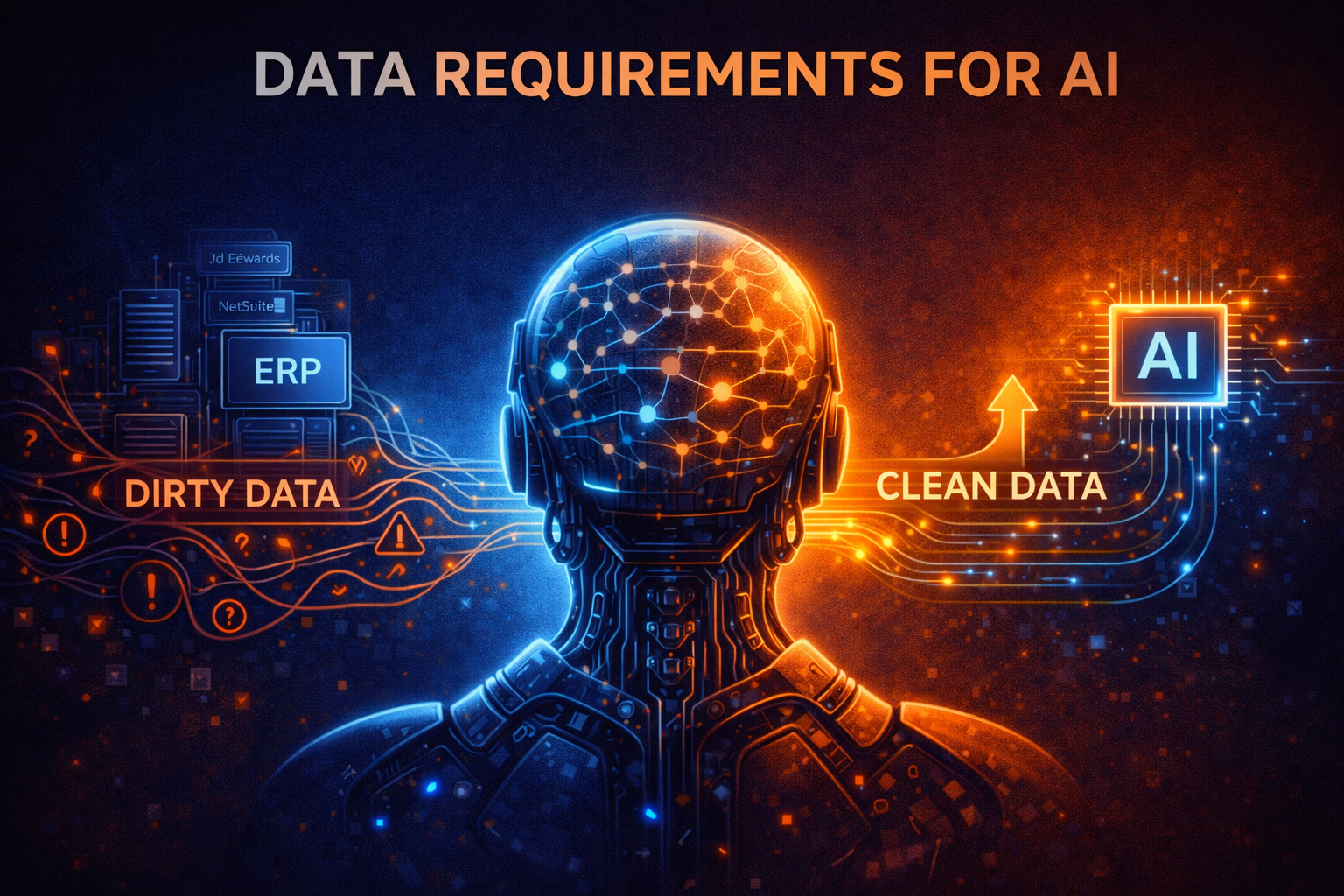
Every data science team hits the same wall eventually. The proof-of-concept model performed well. The demo data was clean, consistent, and perfectly formatted. Then someone pointed it at the actual production environment, the real JD Edwards transaction history, the actual NetSuite multi-subsidiary consolidation, the live ERP data with three years of field name changes and one major system migration in the middle, and the model fell apart.
Key Insights: Data Requirements for AI in Enterprise Environments
- Most data doesn’t meet AI requirements by default: Informatica’s 2025 CDO Insights survey found that 43% of data leaders cited data quality, completeness, and readiness as a leading obstacle keeping GenAI pilots from reaching production.
- BI data and AI data are not the same thing: A dataset clean enough for business reporting can still fail machine learning data requirements. AI needs deeper history, higher consistency standards, and traceable lineage that most BI architectures don’t provide.
- The data foundation gap kills projects in production: S&P Global Market Intelligence reported in 2025 that 42% of companies were abandoning the majority of their AI initiatives before reaching production, up from 17% the prior year.
- Redesigning workflows first is a key differentiator: McKinsey’s 2025 State of AI found that high performers were nearly three times as likely to have fundamentally redesigned workflows, and that strong technology and data infrastructure were among the practices most associated with meaningful AI value.
- ERP data needs specific preparation for AI: JD Edwards, NetSuite, Vista, and OneStream environments carry encoded field names, repurposed columns, and fragmented historical records that require domain-specific transformation before AI models can use them.
- Data governance for AI extends beyond data quality: AI models need data lineage, drift detection, and version-controlled feature definitions, capabilities traditional data governance frameworks weren’t built to provide.
- A unified data lakehouse solves the BI-to-AI gap: Medallion architecture (bronze/silver/gold layers) serves both structured BI reporting and AI training workloads from a single governed platform without building separate infrastructure.
The instinct is to blame the model. The algorithm needs tuning. The vendor oversold the technology. Maybe the use case was wrong for this industry. But that diagnosis is almost always wrong. The model isn’t broken. The data feeding it doesn’t meet what AI actually requires.
This gap between “data we have” and “data AI needs” is where most enterprise AI initiatives quietly fail. And it’s solvable, but only if you understand specifically what the data requirements for AI are, not just generally that “data quality matters.” Data requirements for AI are concrete and testable. You can audit your current environment against them. You can build toward them systematically. And closing the gap between where your data is today and where it needs to be for production AI is the single most impactful investment a data leader can make.
As Adam Crigger, CEO of QuickLaunch Analytics, puts it in the Building AI That Works: The AI Readiness Playbook, co-authored with Fivetran: “The organizations that succeed with AI aren’t the ones with the most sophisticated models. They’re the ones that got their data foundation right first.”
Data requirements for AI are the specific standards of quality, consistency, completeness, governance, and architecture that AI and machine learning models need to learn reliably, generalize accurately, and maintain performance over time in a production environment. These data requirements for AI differ from BI data standards in both degree and kind. An enterprise data environment optimized for reporting and dashboards will fail multiple AI requirements in most cases, not because the data is wrong, but because it was never designed to support machine learning workloads.
What AI Actually Needs That BI Doesn’t
A Power BI dashboard can work acceptably with data that’s 98% clean. Missing values get excluded from aggregations. Outliers get filtered. Field inconsistencies get resolved by analysts who know the system and apply judgment. A report published on Monday morning with 94% data completeness still tells the finance team what they need to know.
An ML model trained on that same dataset will learn the gaps. It will internalize the patterns created by missing values. It will treat outliers as signal rather than noise. It will learn whatever inconsistency exists in the field definitions and generalize from it. The 2% of records that were fine to exclude from a report are part of the training distribution the model builds its predictions from. And when that model encounters clean, complete production data it’s never seen before, its predictions will reflect what it learned from incomplete training data, which is subtly but systematically wrong.
This is why organizations that achieve AI success redesign data workflows specifically for machine learning requirements, not just clean up what was already there for BI. The standards are different, and the difference matters.
BI vs. AI Data Requirements: Why Reporting-Ready Data Fails Machine Learning
| Requirement | BI / Reporting Standard | AI / Machine Learning Standard |
|---|---|---|
| Data Completeness | 94-98% acceptable; analysts fill gaps manually | Typically 99%+ for predictive models; models learn from every gap |
| Historical Depth | 12-24 months typical for dashboards | 3-5 years common for predictive models; more cycles improve reliability |
| Metric Consistency | Tolerable if analysts know the context | Must be identical across all source systems |
| Data Granularity | Pre-aggregated summaries (gold layer) | Raw transaction-level records (bronze/silver) |
| Lineage and Traceability | Nice to have; analysts reconstruct manually | Required for debugging, drift detection, and auditing |
| Update Frequency | Daily or weekly refresh cycles | Varies by use case; operational AI often needs fresher data |
“The gap between AI ambition and AI execution is real, it’s expensive, and it’s growing. And for the data leaders responsible for closing that gap, the problem isn’t a lack of vision. It’s a lack of foundation.”
Building AI That Works: The AI Readiness Playbook
Completeness and Depth of Historical Data
AI and machine learning models learn from patterns in historical data. The depth, continuity, and volume of that history determines what patterns the model can detect and how reliably it can generalize them to new situations.
For predictive models (demand forecasting, churn prediction, anomaly detection, predictive maintenance) a common benchmark is three to five years of consistent historical data with no significant gaps or structural breaks, though the exact requirement depends on the use case and the seasonality of the business. And “consistent” is the critical word. Historical records from before a system migration, before an acquisition added new entities to the chart of accounts, or before a fiscal year restructuring changed how transactions were classified create structural discontinuities. A forecasting model trained on data spanning a system migration will learn the pre-migration distribution and apply it to post-migration records, producing predictions that look statistically reasonable and are practically wrong.
Enterprises running JD Edwards, NetSuite, or Vista frequently discover historical continuity as the first gap in a serious AI readiness assessment. These systems accumulate years of legitimate operational evolution (new business units, acquired subsidiaries, changed product hierarchies, revised cost center structures) that creates discontinuities in the historical record when viewed from an AI training perspective. A data foundation for AI needs to account for these structural breaks, either by building translation layers that normalize historical records across changes or by documenting the discontinuities so models are trained only on consistent periods.
Consistency of Definitions Across All Source Systems
Metric inconsistency is actually the most pervasive AI data quality failure in enterprise environments, not missing data or dirty records. It’s the same business concept defined differently in different systems, creating a training dataset that teaches the model contradictory patterns. Of all the data requirements for AI, this one causes the most damage in production because the errors are systematic and nearly invisible.
“Revenue” is the most common example. In a sales CRM, revenue typically means booked orders or closed opportunities. In a JD Edwards or NetSuite ERP, revenue may mean shipped-and-invoiced transactions. In a financial planning tool, revenue means recognized revenue per accounting standards (ASC 606 for most US enterprises). Train an AI model on “revenue” data drawn from all three systems without normalization, and it learns three different things labeled with the same word. The predictions it generates will be internally inconsistent in ways that are nearly impossible to diagnose after the fact.
Consider a scenario most finance leaders will recognize. The CFO reports a gross margin of 34% in the quarterly review. The divisional controller says their numbers show 29%. They’re both pulling from the same ERP, but corporate calculates margin before allocated overhead, while the division includes it. Nobody is wrong exactly. They’re just not working from the same definition. Now imagine pointing an AI agent at that same data. It will give you a confident answer that is consistently inconsistent.
Definition inconsistency is what an enterprise semantic layer solves. A semantic layer sits between source systems and the analytics/AI tier, providing standardized, consistent definitions for every business metric, applied uniformly regardless of which source system the underlying data came from. Every BI report and every AI model reads from the same governed definitions. Without this layer, AI data quality for multi-system enterprise environments is not achievable at scale.
Forward-thinking teams are also adopting data contracts to formalize these agreements between source system owners and downstream consumers. A data contract specifies the schema, freshness, and quality guarantees a source system commits to delivering. When a JD Edwards administrator adds a column or changes a field type, the contract flags the break before it silently corrupts a downstream AI model. Data contracts turn definition consistency from a manual coordination problem into an enforceable standard.
Data Lineage and Traceability
Business intelligence can tolerate some ambiguity about where a number came from. An experienced analyst can reconstruct the logic from a report specification and database knowledge in most cases. But the data requirements for AI demand full data lineage: the ability to trace every training record, every feature, and every target variable back to its original source system, through every transformation it passed through, to its current representation in the training dataset.
Lineage matters for AI in two ways that don’t apply to standard BI. First, when a model produces wrong predictions (and all models do, eventually), diagnosis requires understanding which data contributed to those predictions and whether that data was accurate. Without lineage, model debugging is guesswork. Second, all production AI models experience performance degradation over time as the real-world data distributions they’re predicting shift away from what they were trained on. Detecting this degradation early, before it causes visible business errors, requires continuous monitoring of input data characteristics against training baselines. That monitoring is impossible without knowing exactly what data the model was trained on.
As the AI Readiness Playbook explains: “When an AI agent runs a workflow, it might access data from three different sources, call two different language models, generate a SQL query, execute it against your data warehouse, and produce a recommendation that gets sent to a business user. Governance needs to span that entire chain.”
Data lineage for AI also means versioning. When a training dataset gets updated and a model is retrained, you need to know what changed between the old dataset and the new one, and whether the model’s performance change reflects genuine improvement or just a shift in input distribution. Data governance for AI requires treating training datasets with the same versioning discipline you’d apply to production software code, not as ad-hoc queries regenerated on demand.
Governed Feature Engineering at Scale
Raw ERP data and machine learning feature requirements are not the same thing. A JD Edwards F4211 sales detail record contains dozens of fields, and the AI features actually useful for a demand forecasting model might include rolling 30/60/90-day purchase windows, seasonality indices, supplier reliability scores derived from purchase order fulfillment history, and inventory velocity ratios. None of these exist as fields in the source system. They have to be computed from raw data through a process called feature engineering.
Where enterprise AI gets hard is doing feature engineering in a governed, reproducible way. An analyst computing features manually in a notebook for one POC is not the same as a production AI data pipeline that regenerates those features nightly from live ERP data, applies the same business logic that was used during training, and makes them available to the model serving layer on a reliable schedule. And when the business definition of “inventory velocity” changes, or when a new acquisition adds different inventory classification schemes, those changes need to propagate through feature engineering logic correctly and consistently.
Most enterprise teams underestimate this requirement. Getting feature engineering right for a single model is an analytics task. Getting it right across multiple models, multiple ERP systems, and ongoing business evolution is a data engineering infrastructure problem. Organizations running JD Edwards Application Packs or NetSuite Application Intelligence have a structural advantage: the domain-specific business logic for ERP feature computation is already embedded in pre-built transformation layers, which dramatically reduces the custom engineering required.
The AI Readiness Playbook quantifies the scale of this challenge. In the Fivetran/Redpoint AI & Data Readiness survey, 67% of enterprises that had centralized more than half their data still spent over 80% of their data engineering resources maintaining pipelines, leaving almost no capacity for feature development or AI workloads. Automated data movement infrastructure is the prerequisite that frees teams to focus on the feature engineering work that actually creates AI value.
Architecture That Serves Both BI and AI Without Duplication
Architecture may be the most important of all data requirements for AI in enterprise settings. Most enterprise data environments were built for one workload type: structured analytical queries against clean, aggregated, business-ready datasets. That’s the traditional data warehouse model. It does BI well. It fails AI workloads for the reasons covered above: it doesn’t preserve raw historical granularity, it applies business transformations that remove context AI needs, and it can’t support the scale of feature computation that production ML pipelines require.
Building a separate AI data infrastructure alongside the existing BI environment is the path organizations take when they don’t have a unified data lakehouse. It’s expensive, it creates data duplication, it means two separate governance frameworks to maintain, and it creates exactly the kind of inconsistency between AI outputs and BI reports that destroys organizational trust in AI. When your forecasting model and your existing BI dashboard produce different numbers for the same metric, nobody knows which one to believe, and the answer is usually “neither.”
“If your BI dashboards pull from one set of tables and your AI models train on a different copy of the same data, you will get different answers. It’s not a matter of if. It’s a matter of when. And when it happens, it destroys trust in both systems.”
Building AI That Works: The AI Readiness Playbook
A lakehouse architecture resolves this by running both workloads from the same platform. Bronze layer: raw source data preserved with full historical depth and original field structures. Silver layer: cleaned, standardized, and governed data with consistent definitions and validated quality. Gold layer: business-ready aggregations and semantic models for BI reporting. AI models access bronze and silver for training granularity. BI tools query gold for reporting. Every tool reads from the same governed source. Metric definitions are consistent. Governance applies uniformly. And every AI model output can be directly reconciled with the corresponding BI report, because they’re both reading from the same foundation.
In an MIT Technology Review Insights survey cited by Databricks, 74% of technology leaders said their organizations had adopted a lakehouse architecture, and nearly all lakehouse adopters said it was helping them achieve their data and AI goals. The question is no longer whether the lakehouse model works. It’s whether your organization has implemented it with enough governance depth to support AI workloads alongside BI, and for most, as the AI Readiness Playbook details across its five dimensions of AI readiness, the answer is “not yet.”
Turning AI Data Requirements Into a Buildable Plan
These five requirements aren’t a checklist you pass or fail in one audit. They’re a maturity spectrum, and understanding exactly where your organization stands on each data requirement for AI is the first step toward closing the gap. Most enterprises are partway there on some dimensions and further behind on others. The value of mapping specifically where your environment stands against each requirement is that it converts “our data isn’t ready for AI” (an accurate but unactionable assessment) into a prioritized list of concrete changes with clear dependencies and estimated impact.
The AI Readiness Playbook offers a practical 90-day roadmap for closing these gaps, organized by maturity stage. For organizations at early maturity, the focus is getting critical data flowing into a cloud lakehouse within the first 30 days. For mid-maturity teams with centralized data, the priority shifts to building out the semantic layer with AI-readiness metadata: table descriptions, synonym mappings, and verified answers that tools like Power BI Copilot and Databricks Genie need to produce trustworthy outputs. For advanced organizations, the 90-day plan centers on deploying evaluation frameworks and getting the first AI workload into production with full governance.
For most enterprises running JD Edwards, NetSuite, Vista, or OneStream, the highest-leverage starting point is the integration and enterprise semantic layer. Connecting ERP source data to a governed lakehouse through certified connectors, and building the enterprise semantic layer that standardizes metric definitions, solves Requirement 2 (consistency) and Requirement 5 (architecture) simultaneously and creates the foundation on which historical completeness, lineage, and feature engineering can be built progressively.
The good news is that this doesn’t require rebuilding your entire data environment from scratch. Organizations using pre-built Application Intelligence with certified ERP connectors can establish a production-ready AI-ready data foundation in 8-12 weeks. The ERP-specific transformation logic (the JDE field translations, the NetSuite consolidation rules, the Vista job cost mappings) comes pre-built, which is where most of the 12-24 month timeline of custom builds actually goes. IGI Wax proved this dramatically: once their JD Edwards and manufacturing system data was unified in a QuickLaunch-powered lakehouse, they applied machine learning models that identified optimal manufacturing settings, reducing waste from 8.5% to under 3% and increasing annual profit by $8-10 million.
When These Requirements May Not Apply
Not every AI initiative requires meeting all five requirements at full maturity. Rule-based automation projects (such as automated invoice matching or simple classification tasks) can work with less historical depth and looser governance than predictive models. Organizations deploying pre-trained large language models for internal knowledge retrieval (RAG-based chatbots) need strong governance and data freshness but may not need three to five years of historical training data. And single-system AI use cases that only touch one ERP module face fewer consistency challenges than cross-functional models pulling from four or five source systems.
The requirements above apply most directly to organizations building predictive, prescriptive, or agentic AI on enterprise operational data: demand forecasting, anomaly detection, margin prediction, customer health scoring, and similar use cases where the model learns from your historical patterns. If your first AI project is narrower than that, start with the requirements that match your specific use case and expand governance as you scale.
Where to Start
For a deeper look at the three foundations every AI platform needs (automated data movement, governed lakehouse architecture, and a trusted enterprise semantic layer), plus a practical 90-day roadmap organized by maturity stage, download the Building AI That Works: The AI Readiness Playbook, co-authored by QuickLaunch Analytics and Fivetran.
Frequently Asked Questions
What are the core data quality requirements for AI and machine learning?
AI models require completeness, consistency, accuracy, freshness, and traceability, all at higher standards than BI demands. The critical difference is tolerance: a dashboard works fine at 98% clean data, but an ML model trains on everything it receives, including the problematic 2%, and generalizes from it. Beyond standard cleaning, AI requires identical business definitions across all source systems, records that correctly reflect real events, updates frequent enough to reflect current conditions, and full lineage from source through all transformations.
Why does data governance matter specifically for AI models?
Data governance prevents silent model degradation after deployment. Without it, the data environment drifts over time: formats change, field definitions shift, new entities appear unmapped. The model keeps predicting based on its original training data while production inputs gradually become something different. Effective AI governance requires data lineage tracking, versioned training datasets, and monitoring dashboards that compare input distributions against training baselines.
What is data lineage and why does AI require it?
Data lineage is the ability to trace every record from source system through all transformations to its final use in a model. AI requires it for debugging and drift detection. When a model produces wrong predictions, diagnosis requires identifying which training records contributed to the incorrect output and whether those records were accurate. Without lineage, this investigation is guesswork. And when a production model’s performance degrades (as all models eventually do as real-world conditions evolve), detecting the degradation early requires continuous monitoring of input data characteristics, which means comparing current inputs against exactly what the model was trained on.
How does fragmented ERP data affect AI model performance?
Fragmented ERP data prevents the cross-functional training datasets that give enterprise AI its practical value. Most high-value AI use cases in manufacturing, construction, and finance require combining data from multiple ERP modules or multiple systems. When ERP data lives in disconnected systems or isolated modules with no unified integration layer, building these training datasets requires manual assembly and reconciliation that can’t scale. A unified data foundation with certified ERP connectors and a governed semantic layer eliminates these integration gaps and provides the consistent, combined datasets that production AI requires.
What is the difference between data that supports BI and data that supports AI?
BI data is built for structured queries against clean, aggregated datasets; AI data requires deeper history, higher consistency, finer granularity, and full traceability. BI needs to be accurate enough for human analysts to trust dashboards. AI needs higher consistency standards (because ML models learn from everything, including edge cases), deeper historical continuity (because predictive models need years of unbroken history to detect seasonal and cyclical patterns), lower-level granularity (because feature engineering requires raw transaction records, not pre-aggregated summaries), and full traceability (because model debugging and drift detection require knowing exactly what data the model was trained on). A data lakehouse optimized for both workloads provides the gold layer for BI reporting alongside bronze and silver layers for AI training.
How much historical data does an AI model need?
Most enterprise predictive models need three to five years of consistent, unbroken history. Seasonal forecasting models need at least two to three full seasonal cycles to learn reliably. Anomaly detection models need enough history to establish what “normal” looks like across a full range of business conditions. Churn prediction models need enough customer history to observe the full lifecycle from acquisition through multiple renewal decisions. The more important constraint is consistency rather than volume. Three years of consistent, clean, well-governed historical data from a unified lakehouse will produce better model performance than seven years of fragmented data spanning a system migration, two acquisitions, and multiple ERP configuration changes that broke historical continuity.
What does a data lakehouse provide that a traditional warehouse cannot?
A data lakehouse provides raw historical granularity, workload flexibility, and unified governance across both BI and AI. A traditional warehouse stores data in one refined, aggregated form optimized for BI queries. It’s excellent for reporting but strips out the raw granularity that AI training requires. The medallion architecture of a data lakehouse preserves data at all three levels simultaneously: bronze (raw source data exactly as it came from ERP systems), silver (cleaned and standardized data with quality rules applied), and gold (business-ready aggregations for BI). Both workloads share the same governance framework, the same lineage tracking, and the same metric definitions, eliminating the inconsistency between AI outputs and BI reports that occurs when organizations maintain separate data environments for different workloads.
How do you know when your data meets AI requirements?
Your data meets AI requirements when you can answer yes to five questions: Can you automatically combine data from all relevant source systems (ERP, CRM, financial planning) without manual intervention? Do all departments use identical definitions for core business metrics? Can you trace any AI model prediction back to the source data records that contributed to it? Do you have at least three years of consistent, unbroken historical data with no structural breaks? And does your current architecture support AI training workloads and BI reporting from the same governed platform without maintaining separate data environments? If any of these answers requires significant qualification, an AI readiness assessment will identify which specific gaps are blocking production AI deployment and what the remediation path looks like.