Every enterprise runs on multiple systems. ERP platforms handle operations. CRM tools manage customer relationships. Financial planning applications track budgets and forecasts. Each one collects mountains of data, and almost none of them talk to each other. The result? Data silos that quietly drain millions from your bottom line while your teams spend their days hunting for numbers instead of acting on them.
If your leadership meetings regularly devolve into arguments about whose spreadsheet has the right revenue figure, you already know this problem firsthand. You just might not have a name for it yet.
What Are Data Silos, Exactly?
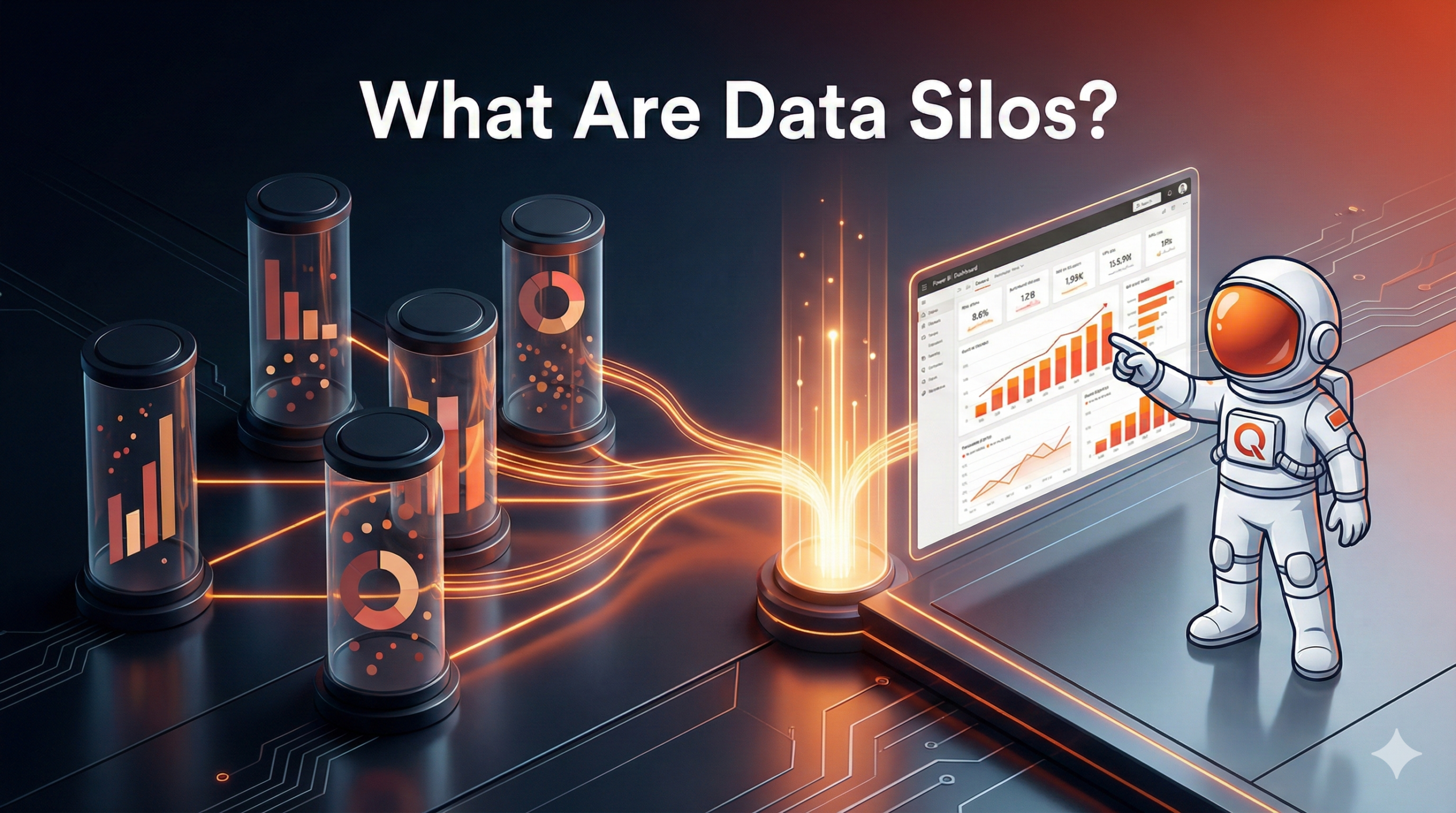
Data silos are isolated pockets of information that exist within one department, application, or system and remain inaccessible (or at least difficult to access) for the rest of the organization. They form when business units adopt separate tools, store records independently, and develop their own definitions for common metrics like “revenue,” “margin,” or “customer.”
A finance team running JD Edwards, a sales team tracking deals in Salesforce, and an operations group pulling production reports from a manufacturing execution system will each hold pieces of the same business picture. But without a unified enterprise analytics platform, those pieces never come together. Each department ends up operating with its own version of the truth.
Data silos are not the same as data security boundaries or access controls. Controlled access is healthy governance. Silos, on the other hand, are accidental barriers: the unintended consequence of organic growth, acquisitions, department-level software purchases, and years of patchwork IT decisions.
How Data Silos Form in Enterprise Environments
No company sets out to create data silos deliberately. They accumulate over time through a handful of recurring patterns.
Department-level purchasing decisions are one of the biggest drivers. When sales buys a CRM, finance implements an ERP, and HR adopts a separate HRIS platform, each system is optimized for its own department. Cross-functional data integration was never part of the original plan.
Mergers and acquisitions compound the problem. An acquiring company might absorb two or three additional ERP instances overnight. The Washington Companies, for example, operates seven separate JD Edwards instances across its diversified portfolio of railroads, mining, shipyards, and manufacturing businesses. Before they adopted a unified data foundation, connecting information across those instances required weeks of manual effort.
Legacy systems and custom workarounds create another layer of fragmentation. Older on-premise databases may lack modern APIs or connectivity options. Over the years, IT teams build point-to-point integrations, custom ETL scripts, and manual export routines, all of which become brittle and expensive to maintain.
Organizational culture plays a role too. When departments are incentivized to optimize their own metrics without visibility into how those metrics affect the broader business, they naturally build their own tracking tools and reporting workflows. Before long, every team has its own “source of truth,” and none of them agree.
The Real Financial Impact of Data Silos
The cost of data silos goes far beyond IT budgets. It shows up in lost productivity, missed market opportunities, compliance exposure, and eroded trust in organizational decision-making.
Wasted Analyst Time
Finance teams and operations analysts at mid-to-large enterprises often spend the majority of their working hours collecting, cleaning, and reconciling information pulled from multiple systems. That work gets done in spreadsheets, through manual exports, and with heroic copy-paste efforts that nobody outside the department ever sees.
The irony is hard to miss: companies hire expensive analysts to drive strategic decision-making, then saddle them with data janitorial work that automation should handle. When your highest-paid knowledge workers are spending their weeks wrangling CSVs, the return on that talent investment drops fast.
Conflicting Reports and “Meeting Math”
Data silos create a uniquely frustrating organizational dynamic where different departments show up to the same meeting with different numbers. Sales says revenue grew 15%. Finance says 12%. Operations puts the figure at 18%. Nobody is lying. They’re just pulling from different systems with different definitions, different time windows, and different calculation logic.
This “meeting math” problem consumes leadership bandwidth that should go toward strategic decisions. Instead of debating where to invest next quarter, executives spend the first 30 minutes of every meeting arguing about which set of numbers to trust.
Slow Time-to-Decision
When answering a straightforward cross-functional question (“Which customers are actually profitable when you factor in support costs, returns, and payment terms?”) requires pulling data from five separate systems and manually reconciling it in Excel, that question doesn’t get answered in a day. It takes weeks. And by the time the answer arrives, the market has moved on.
Research consistently shows that the speed of decision-making is directly correlated with organizational performance. Data silos are one of the most common bottlenecks that slow that speed down.
Shadow Systems and Compounded Fragmentation
When people stop trusting the “official” reports, they build their own. Departments create shadow spreadsheets, personal databases, and ad hoc tracking tools that nobody else can access or verify. Now you have data silos within data silos: a compounding problem that gets worse every quarter it goes unaddressed.
Compliance and Audit Exposure
Fragmented data environments make it difficult to demonstrate consistent data lineage during audits or regulatory reviews. If your organization operates in a regulated industry (financial services, healthcare, construction, manufacturing), the inability to produce a single auditable trail from source systems to final reports is a genuine risk, not just an inconvenience.
Five Warning Signs Your Organization Has a Data Silo Problem
Not every organization recognizes its data silos immediately. Here are five diagnostic indicators that suggest your enterprise is paying what amounts to a hidden “data silo tax” on every decision:
- Analysts spend more time gathering data than analyzing it. If your finance and operations teams dedicate most of their time to collecting and preparing information rather than interpreting it, the root cause is almost always disconnected systems.
- Leadership meetings regularly turn into debates about data accuracy. When different departments produce different numbers for the same metric, the organization’s strategic conversations get hijacked by reconciliation exercises.
- Critical business questions take weeks to answer. If assembling a complete picture requires manual data gathering from multiple platforms, time-sensitive opportunities disappear before decisions can be made.
- Departments maintain their own “shadow” tracking systems. Parallel spreadsheets and workarounds signal a fundamental lack of trust in centralized reporting, and they make the fragmentation worse.
- You cannot connect operational performance to financial outcomes in a single view. Questions like “Which production issues are costing us the most?” or “Which product lines are truly profitable?” require a unified data model that most siloed organizations simply do not have.
If three or more of these sound familiar, the cost is likely significant.
Breaking Down Data Silos: What Actually Works
Recognizing the problem is one thing. Solving it is another. Many enterprises have tried, and failed, to unify their data through custom-built integrations, department-level BI tools, or one-off data warehouse projects. Those approaches tend to stall because they lack the deep application-level expertise needed to interpret the cryptic schemas, custom codes, and business logic embedded in systems like JD Edwards, Vista, or NetSuite.
After two failed attempts over 18 months with premier Microsoft partners to build custom analytics for their JD Edwards environment, The Washington Companies discovered that even skilled technology consultants couldn’t navigate the ERP’s complexity without embedded domain knowledge. The cost of those two failed attempts to build a single GL data mart exceeded what it ultimately cost to deploy a complete, multi-module analytics solution.
The Three-Phase Approach That Works
Organizations that successfully eliminate data silos tend to follow a structured methodology rather than trying to boil the ocean. One framework that has proven effective across industries breaks the problem into three phases:
Connect
Automate data extraction from all source systems using certified connectors and change data capture (CDC) technology. This replaces manual exports and brittle point-to-point integrations with reliable, scheduled pipelines. Pre-built connectors for major ERP and CRM platforms, including JD Edwards, Vista, NetSuite, OneStream, and Salesforce, eliminate the need to build extraction logic from scratch.
Centralize
Land the data in a modern data lakehouse architecture that combines the governance of a traditional data warehouse with the flexibility and cost efficiency of a data lake. Platforms like Databricks and Microsoft Fabric support a medallion architecture (bronze, silver, gold layers) that progressively refines raw data into analysis-ready business datasets.
Conquer
Apply an enterprise semantic model with pre-built, validated calculations and KPI definitions on top of the centralized data. This is the layer that translates raw tables and cryptic codes into business-friendly metrics that everyone across the organization can trust and use.
This connect-centralize-conquer approach is designed to deliver value at each stage, so organizations see measurable ROI well before the full project is complete.
What Becomes Possible When Data Silos Disappear
The benefits of eliminating data silos go beyond cleaner reports. When information flows freely across organizational boundaries, entirely new capabilities open up.
Financial close acceleration. IGI Wax reduced their accounts receivable credit dispute resolution time from two to four hours down to five minutes after unifying their JD Edwards data, a 23x productivity gain that freed their finance team to focus on strategic analysis instead of manual reconciliation.
Equipment utilization optimization. The Washington Companies achieved a 50% reduction in equipment idle time after deploying unified analytics across all seven JD Edwards instances. That operational improvement translated directly into $6 million in additional monthly revenue.
AI and machine learning readiness. This is where the long-term value multiplier lives. AI and ML models require clean, connected, governed data to function properly. You cannot train a predictive model on fragmented information from five different systems with five different definitions of the same metric. IGI Wax proved this: once their manufacturing and ERP data was unified, ML models identified optimal production settings that cut waste from 8% to 4%, generating $8-10 million in increased annual profit. That outcome was impossible before the data silos came down.
Organizations that continue operating with siloed data aren’t just leaving money on the table today. They’re locking themselves out of the AI-driven competitive advantages that will define the next decade.
How to Calculate Your Organization’s Data Silo Costs
If you want to quantify the specific impact of data silos in your enterprise, start with a structured assessment. Audit how many hours your analytical staff spend gathering and reconciling data versus performing actual analysis over the course of a month. Document the time lag between identifying a need for information and receiving actionable answers. Identify specific missed opportunities caused by delayed or incomplete data. And survey your leadership team on their confidence level in the numbers they see in reports.
Most organizations that complete this exercise discover that the cost of their data silos far exceeds the investment required to implement a unified enterprise analytics solution.
Ready to Break Down Your Data Silos?
See how QuickLaunch Analytics can unify your enterprise data in weeks, not years. Learn how the Connect, Centralize, Conquer framework applies to your specific systems and use cases.
Request a Personalized DemoFrequently Asked Questions
What are data silos and why do they form in enterprise environments?
Data silos are isolated repositories of information that are trapped within a single department, application, or system and remain inaccessible to the rest of the organization. They form through department-level software purchases, mergers and acquisitions that introduce additional ERP instances, legacy systems that lack modern integration capabilities, and organizational cultures that incentivize teams to optimize their own metrics independently. Over time, these factors create a fragmented data environment where every department operates with its own version of the truth.
How much do data silos cost an enterprise organization each year?
The cost varies by organization size and complexity, but DATAVERSITY’s 2024 Trends in Data Management survey found that 68% of organizations cite data silos as their top data management concern. Costs show up as wasted analyst time spent on data gathering instead of analysis, delayed decisions that miss market windows, conflicting reports that derail strategic discussions, shadow spreadsheet systems that compound fragmentation, and compliance risks during audits. For mid-to-large enterprises running multiple ERP and CRM systems, the combined financial impact typically reaches into the millions annually.
What is the difference between data silos and data security controls?
Data security controls are intentional access restrictions that protect sensitive information through role-based permissions and governance policies. Data silos, by contrast, are unintentional barriers that prevent different parts of an organization from accessing information they legitimately need for business decisions. Healthy data governance maintains security boundaries while still enabling cross-functional visibility through a unified analytics platform.
Can data silos be fixed without replacing existing ERP and CRM systems?
Yes, data silos can be addressed without replacing your existing enterprise systems. The most effective approach uses automated data pipelines and certified connectors to extract information from your current ERP, CRM, and financial platforms (including JD Edwards, Vista, NetSuite, OneStream, and Salesforce) and centralize it in a modern data lakehouse. This strategy preserves your existing technology investments while creating a single source of truth on top of them.
How long does it take to eliminate data silos across an enterprise?
The timeline depends on whether you build custom or use a pre-built framework with deep application expertise. Custom integration projects typically take 12 to 24 months to deliver initial value, and many fail entirely. Organizations that use pre-built Application Intelligence with certified connectors and industry-specific data models can achieve initial production value in 8 to 12 weeks. The Washington Companies, for example, deployed unified analytics across seven JD Edwards instances in just 12 weeks after two prior custom attempts had failed over 18 months.
How do data silos affect an organization’s ability to implement AI and machine learning?
Data silos directly block AI and machine learning initiatives because these technologies require clean, connected, and governed data to produce reliable results. You cannot train a predictive model on fragmented information scattered across multiple systems with inconsistent definitions and formats. IGI Wax demonstrated this clearly: AI-driven manufacturing optimization that delivered $8-10 million in annual profit improvement was only possible after their data silos were eliminated and their ERP and production data was unified in a governed data lakehouse.
What is the first step toward breaking down data silos?
The first step is conducting a current-state assessment. Document all significant data sources across the organization, map the data flows between them, identify where manual transfers and workarounds exist, and quantify the time your teams spend on data gathering versus analysis. This assessment gives you a clear picture of where the most costly disconnects live and helps you prioritize which integrations will deliver the fastest return on investment.